Friday, September 19, 2014

Sleep...and keeping your kids in their cribs: Part 2


You've worked so hard to transition your babies into a crib, and to train them to sleep at night, and knowing they're safe in their cribs gives you peace of mind.  And then they figure out how to get out and it's all over!  Then you have to either train them to stay in the crib and not get out unless you take them out, or if you're worried about safety you have to transition to a toddler bed, perhaps earlier than you'd planned.

I'll never forget the first morning I heard the running feet and noises getting closer and closer...  The boys had gotten out of their cribs one morning for the first time (see my post here) and then somehow forgot about it.  But that fateful morning that they burst into our room I'd left both their door and our door open because they had cried a lot in the evening and I wanted to hear them if they woke again.

What we did:

  • We turned their cribs so the highest side was away from the wall.  This did not deter them from climbing out AT ALL.  (To my husband, "you were right.")
  • I strongly "encouraged" them to stay in their cribs at nap time.  (I actually don't mind if they get up to play in the early morning in their room, but I need my afternoon break!)
  • I put up a gate to the bedroom door even while they were sleeping.  This was mainly for safety, since I don't want them wandering the house at night if they happen to get up and out.  Also, one of my sons had opened the door to the garage for the first time, and I didn't want them somehow unlocking or opening doors and leaving the house while I'm sleeping and not supervising! 
  • We tried sleep sacks.  I ordered super-long, toddler-sized ones.  I chose the Halo SleepSack in lightweight knit, so it wouldn't be too hot over their winter clothes.  As you can see below they did fit my tall toddlers, but the leg openings still allowed them enough range of movement to swing their leg over the side of the crib!


More suggestions from twin moms on keeping your babies/toddlers in bed:

  • Use a "Peapod."  Click here to see an example.  These are portable, zip-up, tent-like sleeping beds.  A member of my local twins club used hers by setting them right inside her cribs after converting the cribs to toddler beds.  She also says twisty ties can keep the zippers in place, since her twins quickly learned how to unzip the pods.  
  • If using sleep sacks, and your child learns how to unzip it, another member of my club sewed her own version of a sleep sack that had snaps in the back instead of a front zipper.  
  • If putting the crib mattress on the floor within the crib itself, don't just lay the mattress touching the floor, as it will too easily slide around.  Unscrew and lay the original crib bottom on the floor, then put the mattress on top.  
  • Pray.  

Some of these things might work to slow your children down or prevent their crib escapes.  Eventually, as you can see from the title picture above, we took the plunge and switched to toddler beds!  Stay tuned for a post on this transition!

Snuggling with daddy after a nap.  

Monday, September 15, 2014

Preparing for a Consignment Sale

It seems my Facebook and inbox are flooded in the fall and spring with notices of consignment sales.  If you're not involved in these, you're likely familiar with garage sales.  Sales can be a great way to make back a marginal amount of the money you spent on your children's gear and clothing.  Here are some tips on preparing for a consignment/garage sale.

Prep:
  • Find a container where you can set aside items you mean to sell.  A shopping bag, plastic garbage bag, laundry basket, anything will do, as long as it won't get confused with other items in your house, and can be shoved into a place where your children won't find it!  I tend to stick things in that spot throughout the year as we are finished with them.


  • Obviously, you want to launder or clean your items as well as possible before trying to sell them. Try to find all the parts, and keep manuals to go with larger items.  
  • If your consignment sale has rules about how to price and label items, follow it to a 'T.'  You don't want to cause unnecessary confusion in receiving your share of profits.  
  • Colored dot circles.  If you're in charge of your own garage sale or table, then labels such as these from Office Max, will do just fine.  Use a sharpie so people can see the price more clearly.  

  • Advertise.  If you're part of a large organization's consignment sale, then they probably do some advertising.  But don't leave it at that!  Get the word out among your friends, family, neighbors, and social media circles about the sale.  The more customers means the more likely you are to sell things.  

Pricing:
  • My local club sale suggests pricing items at 70% off retail value.  Sometimes you can get away with pricing things higher, sometimes you may need to go even lower.  If you're doing a large consignment sale, you can sometimes walk around and peruse other people's tables and prices, and gauge from there.  Start with a higher price and lower prices towards the end of the sale if you aren't selling well. 
  • Negotiate.  Many customers may enjoy haggling, so be prepared to negotiate prices.  If someone won't pay $5 per pair of pants, offer to sell two pairs for $8, for example.  You may want to have in your mind, for larger items, the price you won't go below. 

Showcase:
  • If you have a lot of small, related items that you think may not sell well, put them all in a zip-top plastic bag and sell as one item.  For example, I had several train set odds and ends that didn't fit my children's track system.  I put them all in a bag labeled "Train Accessories," and sold it for $5.  I've seen women sell a lot of little cars or other toys and label them as "Grab Bags." 
  •  Find your items online, and print off a page to show its value.  Circle the retail price in marker, and next to it write your price.  Tape the sheet to the item.  Customers will have a clear visual on what a deal they are getting!  (It's up to you to print off either the lowest online price you can find, knowing customers may be price-checking, the highest price you can find, or somewhere in between.)  


  • Clothing racks.  These make displaying and perusing clothing easier.  I got away without one because I sold very little clothing at my last sale.  The items I did have I put on hangers and hooked them to the edge of my table.  If you can't borrow a rack, some places rent them.  They do say that clothing that is hung up sells better.  
  • Hangers.  For the purpose of hanging, save any little children's plastic clothing hangers that you come across throughout the year.  

What to bring:
  • Folding chair.  You don't want to be sitting down the whole time, and looking like you don't care, but you will get tired eventually.  
  • Food, snacks, and drinks.  If the sale starts early, I like to treat myself to a drive through for coffee and breakfast, and eat it on the way or while setting up the sale.  
  • Change!  If you're in charge of your own table, you'll have to make your own change.  Bring plenty of one dollar bills, and a handful of larger bills.  If you price your items only in dollar increments, rather than in 25-cent increments, you won't have to worry about having quarters for change.  However, it's up to you on what you want to deal with.  Some items may not even seem to be worth a dollar, in which case go ahead and price it lower, and bring coins for change. 
  • Wagon or stroller.  Some larger sales have rolling carts to bring things in from the cars.  If not, think about how you're going to unload your vehicle and carry everything into the sale venue!   
  • Table cloth.  A suggestion from a member of my multiples club, this helps to brighten up your table and draws attention.  It can be any color or fabric, even a cheap plastic table cloth from the party supply section of stores can work.  

Have fun!
  • Remember, if you don't sell everything, that's okay!  There are plenty of worthy organizations to which you can donate, or you can keep things to try at another sale.  Or, you can post your items to sell online.  Lots of options!  
  • Be engaging.  I smile, say hello or good morning to everyone who approaches my table or who even walks by.  I ask what they're looking for, the ages of their children, anything to get them talking to stay longer and take a closer look at my items.  This way I can also point out more effectively what might interest them.  Talk up your items and how useful they were to you!  
  • Have a buddy.  If you're in charge of manning your own table, try to be next to someone you know, or enlist a friend to set up a table of her own next to you.  That way you'll have someone to chat with when things are slow.  You can also take turns watching over each other's tables, while the other person takes bathroom breaks or does their own shopping.  
This is from ConsignmentMommies.com.   I confess that my last sale was a total wash, since I bought about the same amount that I sold!

Happy selling!  (And shopping...)

Friday, September 12, 2014

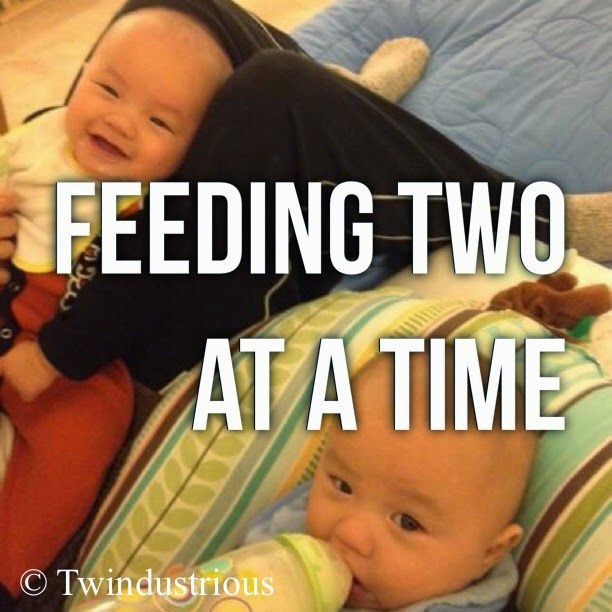
Feeding Two At A Time: Part 1, Nursing and Bottle-Feeding

Feeding two babies at one time is challenging!  But with practice, you can master all sorts of methods.  In this post I'll just be explaining what we did, and what worked for us.  This post, Part 1, deals with babies; Part 2 will discuss feeding two once you start solids.

When the twins first came home, we were doubly blessed with the two boys, and you might say quadruply (is it a word?) blessed to have both my parents living with us for the first couple of months.


When you have extra people around to help:


  • Nurse one baby while someone else bottle-feeds the other baby.  (Sometimes the bottle had pure pumped breast milk,  sometimes it was supplemented with formula if I hadn't pumped enough, and sometimes it was just formula.)  I kept track so that each baby had the same amount of "turns" nursing.  
  • Tandem nurse.  A few times I had my mom help me to tandem nurse using a large, twin nursing pillow.  But this was always very tricky for me.  It seemed almost impossible to position myself inside the pillow, which wrapped around my waist, insert a back support pillow behind, then balance one tiny, squirmy baby on a side while reaching for the second baby.  Then getting one latched, hoping the other didn't fall off the side of the pillow, getting hot and sweaty, trying to keep clothing out of the way, then doing it all again when the first baby stopped eating and needed to be "re-latched."  It was like a circus.  So, I rarely tandem nursed.
  • Other people bottle-feed babies, while you pump and/or sleep.  Self-explanatory.  One warning, however:  if you're serious about keeping up your milk supply, don't skip too many nursing or pumping sessions in order to rest.  

Eventually, my milk supply completely dried up and the boys became solely formula-fed.  This was bittersweet.  My parents had to go home when the boys were 2.5 months, and my husband was at work every day, so we quickly developed ways for just one person to feed two babies at a time.

When one person feeds the babies:


  • Tandem nurse.  See my description of the circus above!  But I know from first-hand accounts, reading online, books, etc., that this IS possible, and becomes easier with practice.  The "double-football hold" seems to be the most popular position.  The book  Mothering Multiples: Breastfeeding and Caring for Twins and More! can be very helpful.  
  • Nurse one baby at a time.  Train babies to wait their turn while they lay nearby you, or adjust their schedules so that they eat one after the other.  Try and keep track of who nursed on which breast and alternate.  That way if one baby is a stronger breast-feeder, you will help to keep the milk supply somewhat more even on both sides.  This is, however, a more time consuming method.  
  • Prop babies on boppies for bottles (say that ten times fast).  You can lay them semi-sitting up and sit in front or between them on your bed, couch, or on on the floor.    
  • Put one baby in your lap, and another propped next to you, also for bottles.  I usually sat with my back against the headboard of a bed and bent my knees.  Then one baby could sit on my lap facing me    
A cheerful morning feeding!  

  • Place babies in seats, sit between them (again, for bottle feeds).  Sit so that you're facing the opposite direction the babies are facing, so that you can have your back supported by something.  Using the car seats was my mother-in-law's suggestion, and while it seemed so simple, it revolutionized the way we were feeding the babies!  I placed a towel or blanket under the babies to pad the seats more.  You could also use bouncy seats.  
Our favorite bottle-feeding position.  

In all of these scenarios, have bibs, burp cloths, bottles, remote, pillows, and anything else you think you’ll need for a feeding, ready and reachable.  Afterwards they took turns being burped.  Being on the floor had its advantages, because if one got sick of waiting around in the seat, I could put him on the floor and let him roll or wiggle to his heart’s content.  I spent a lot of time feeding, propped against our couch, watching Netflix.  It was about that time I developed my obsession with "Downton Abbey."


Spot the historical error in this Downton Abbey promo pic!  We were speaking of bottles...

If I wasn’t watching TV, I also could use this feeding time to pray, either silently or out loud, so the babies could hear my voice.  Sometimes I’d sing to them, or just sit and enjoy the silence.  Occasionally, I’d use it as an opportunity to verbalize what would happen that day, what needed to be done.  This was for my own sake; I figured if I said it out loud maybe I’d remember it!

Happy feeding!

Friday, September 5, 2014

Grocery Shopping With Twins

For months after our twin boys were born, we took turns going to the grocery store.  Eventually, I got brave and took the boys.  I stuck them in their car seats, clicked those into our double Snap 'n' Go, and walked.  It happened to be a Trader Joe's grocery store, which, if you're familiar with them, are designed purposely to feel like a small, neighborhood store.  Which means small aisles.  Tricky with something that steers and turns like a bus.  And I could just get whatever would fit in the bag below the car seats.  This is also how I would do the occasional Target run, though that required getting in and out of the car.  But for any trip that required buying a lot at one time, I had to go alone or send someone else.

When the boys were finally sitting up by themselves, we ventured into grocery stores that boasted double-seater carts.  By then we were living in Texas.  (How I love, and miss, HEB!  It's a chain that only exists in certain parts of the state.)  But sometimes the desirable carts were placed in odd locations, not in the parking lot or not even with the regular carts.  A few times, afraid to leave my babies alone in the car, I put them in the double stroller, searched for  the right cart, loaded them in, put the stroller in the cart, returned it to our car trunk, THEN went shopping.  Waaaaaay too many steps.

But not every store HAS double-seater carts, much to my, and I'm sure many a mother of multiples', dismay.  Or worse, stores that have just a few...or one.  Once, after the boys had been walking for awhile, I tried to bravely transfer them from the car to the store without the stroller in between.  I tried to have them walk by holding my hand, occasionally muscling a runner or a layer-downer up into my arms across the parking lot.  We finally entered, only to find no suitable carts.  I asked an employee who said they only had one, and uh, it was being used.  I gave up, and returned my squirmy squirrels to the car.  Then we went to Costco!  Beautiful Costco, where ALL the carts are double-seaters.  More retailers need to invest in these types of carts. (Market Street, I'm talking to you!)  Multiples are on the rise, and besides, mothers with several little ones of different ages surely need more of these carts, too!


Solutions for shopping with twins:

  • Scope out stores beforehand, if possible.  When we moved to a new city, it was oddly fun for me to go around, testing out all the new grocery store chains in our area, or even to see how local branches of familiar chains were laid out.  I could also do some product and pricing comparisons.  I would see if a store had good carts, and if so, WHERE they were kept.  Next time I went with the boys I could try and park as close as possible to those carts. 
  • Be organized.  It took me awhile, but I've finally gotten into a better meal-planning routine, and this helps with my grocery lists.  If you can keep your twin-accompanied grocery runs to once a week or even less, score!  
  • OR, if you don't mind grocery shopping more often (sometimes it's nice just to get out of the house), take your double stroller and just stuff in whatever will fit at that time.  Then go back in a few days for other necessities.  
  • I WISH I had known about this product before (my kids are too big for it now), but it looks very helpful:  the Buggy Bench!  Carry it in the car and just insert into the basket of a cart for an instant, second seat.  
  • When the babies are still tiny, you could also wear one baby, and have the other in their car seat in the basket of the cart.  I have also seen people put one car seat on the riding part of the seat, and one car seat in the basket...but then you have very little room for groceries.  
  • Bring whatever will bring more peace:  bottles, snack cups, sippy cups, pacifiers, etc.!


Happy shopping!

Monday, September 1, 2014

Top 10 Tips: Twins Arrive!

1.  Know that it's going to be crazy.

Don't expect the kind of life your imagination might have cobbled together from television commercials, or other families' carefully coordinated professional photography sessions for Christmas cards.

2.  Be prepared.  

There are a lot of things you can do before the babies come to feel sort of set up.  See my post on top five tips for a twin pregnancy (some of which applies to higher order pregnancies, too).

3.  Don't be surprised if NICU time is required.

A lot of multiples arrive early, and thus, need to spend a little time in the NICU.  There are many parents out there a lot more qualified than I to speak to this.  But don't be disheartened by it:  know that this can be a little added recovery time for yourself, and more importantly, a well-monitored catch-up time for preemies who just might not be ready for this world yet.

4.  Get help!

Most people can't afford night nurses, nannies who help while you're home as well, or even a cleaning lady.  If you CAN, more power to you!  For the rest of us, beseech your family and friends to come at regular intervals.  Get over your pride and ask if nobody volunteers.

5.  Have a night-time plan.

See my posts on Sleep...and what we WISH we had done, and Sleep: tips for making the night go smoothly.

(For even MORE sleep advice, this link goes to a list of all posts on Sleep.)

6.  Create a schedule, but don't worry if you can't stick to it.

By now I'm sure you've heard the mantra that if one baby wakes to eat, feed the other baby, too.  Eventually, you will get more rest if you can get your twins to eat and sleep at the same time.  It can also help you mentally if you know what to expect throughout the day, rather than feeling that each day (or night!) is an endless stretch of the unknown.  A few tips:  In Praise of Routine.

7.  Order stuff online.

While I do recommend learning how to get out of the house with your multiples soon, to avoid cabin fever, I also know it's very difficult.  Sometimes it just seems easier to stay home.  In which case, ordering diapers, formula, pajamas, whatever it may be, from Amazon or Diapers.com can be a very easy and convenient option.  And while we never did it, I've heard online grocery delivery services can be amazing.

8.  Don't compare.

Try and accept early on that your life with two or more babies at one time will NOT look the same as your friend or cousin with just one baby at a time.  I once heard a quote, attributed to Theodore Roosevelt, that "comparison is the thief of joy."


9.  Join stuff. 

I've been a member of a multiples club in two different cities now, and I can't stop gushing about the benefits!  Most groups have an online presence, in which you can ask questions related to twins, buy a used triple stroller for a good price, or be inspired by that mother of quadruplets!  Both groups I've joined had monthly meetings with interesting, relevant speakers, and my current group even serves a free dinner before every meeting!  There are usually play dates and events for the kids, or moms' nights out for happy hour or dinner.  I've made lots of friends this way, and can't say enough about the emotional support these groups can provide.  If you don't have a multiples club near you, join another parent group to meet other people who are (almost) going through the same thing.

Find a multiples club:  Multiples of America

10.  To repeat, remember:  it'll be crazy.

CRAZY.

Friday, May 9, 2014

Top 5 Tips: Twin Pregnancy

1.  Eat!

In the early stages of my pregnancy, I was ravenous.  Then came some morning sickness/nausea, which put a slight damper on eating.  But with twins, you'll get bigger faster, and your stomach will be pushed higher and higher, possibly causing more heartburn. It was so bad at the end, for me, that I didn't enjoy eating as much, because I knew I would pay for it later, and it would even keep me from sleeping.  I was also diagnosed with gestational diabetes towards the end, and it literally took the joy out of eating.  I had to avoid certain things (pretty much everything I liked) and test my blood every few hours.  SO, my advice is to get in those calories as soon as you can, in a healthful way, of course.  In their book "When You're Expecting Twins, Triplets, or Quads: Proven Guidelines for a Healthy Multiple Pregnancy," Barbara Luke and Tamara Eberlein state that a mother expecting twins should gain around 40-56 pounds.  For triplets, 58 to 75, and for quads 70-80.  I did not gain that much, and I think it was partly due to my frame and my inability to eat much at the end.  According to these authors, an ideal diet for a multiple pregnancy is actually related to a diabetic diet, and suggests 3,500 calories a day for a mother expecting twins.  Wow!  I'm not a medical professional, so of course, you should get recommendations from your own doctor; but I did find this particular book very helpful.

When you don't feel like eating, think of your first ultrasound for motivation!  They need nutrients!


2.  Take it easy.

I heard a lot of people talk about how pregnant women could be just as active as anyone else, and I even personally knew women who continued to train for marathons up to 7 months gestation.  Also, lots of people told me that when the second trimester hit, it would be the Golden Age of pregnancy, I'd have more energy and feel better.  Some mothers of multiples may experience it this way, but not me!  I was exhausted at the beginning, and when the second trimester hit, I felt REALLY BAD.  I was tired and literally in pain.  I should have listened to my body's signals, and rested more.  I felt blessed that I finished my school year teaching kindergarten at around 3 or 4 months, after which I resigned.  But I was still trying to take a long walk for exercise every day (and feeling exhausted after a block), and doing errands, and took a few trips.  I understand that we should be healthy (and have a life), and there's also the nesting drive, pushing us to want to have everything ready for the babies!  And many of us are working and have other little ones already.  But, if and when possible, take it easy!

I'd like to stress something here:  Multiple pregnancies are on the rise, but this doesn't make them less risky.  Multiple pregnancies are still, technically, high-risk pregnancies compared to single pregnancies.  They are different and should be treated differently!  Listen to your body, listen to your doctor.  There is no shame in taking a nap or putting your feet up when you can!

3.5 Months along and not very big yet, but already needing more rest than usual!


3.  Be prepared.

Many women expecting twins and other higher order multiples end up needing to go on bed rest.  I was on bed rest for my last 2 months.  This will limit many things you may have planned to do.  So, it's not crazy to set up the nursery, or assemble the crib in your room, or whatever you're going to do, as soon as possible.  Try to do errands and any physical tasks early on.  Then, if you do end up on bed rest, you can do all the sitting-down activities: setting up online registries, making and printing baby logs, preparing baby announcements (if you want to) in which you just have to add a photo, make and print address labels for announcements, write thank you notes for things you may have already received, find a pediatrician, etc. Also, we had some insurance nightmares.  Try and do whatever you can before the babies arrive!  Long phone calls and dealing with bureaucracy is only harder with multiple crying infants.  Some of it can't be avoided, of course.  I also cooked a few meals and froze them for later.


4.  Line up help.

We were incredibly blessed to have my parents live with us for the first two months after the babies were born!  My mother had recently retired, and my dad's job could be done online.  But before they even arrived, I was on bed rest and my husband really had to step it up and do everything: work full time, do everything around the house, grocery shop, and drive me to my numerous appointments.  My family was eager and willing to help; if yours is not, do your best to convey the medical necessity of you taking it easy!  If no family is around, or you are single, there is no shame in letting housework slide and cutting out any other unnecessary activities.  Try to draw upon your pre-pregnancy network of friends and acquaintances to help you: maybe someone can do laundry one day a week, another friend might be able to pick something up at the store for you.

Because everything just gets harder at this point: almost 8 months along!

Also look into lining up help for AFTER the babies' arrival.  Can any family members come stay with you for a bit?  Can you afford a night nanny? (We couldn't quite justify that cost, and weren't even very aware of the concept at the time.)  Do you need to start arranging childcare for when you return to work?  And FOOD.  If no one offers, ask your best friend or ANYBODY to set up a meal registry for you.  People love to help, they just need to be organized.  Here are some great sites for that:

MealBaby

SignUp Genius

Take Them A Meal


5.  Do your research...but not too much.

As mentioned above, carrying twins brings risk.  Some doctors are well versed in multiple pregnancies, but you'd be surprised.  In most cases you'll be referred to a specialist to see regularly on top of your usual OB/GYN.  If you're not, maybe you should request that this happens.  So read up on your particular type of pregnancy to gain a working knowledge of the facts.  It's okay if you can't remember every tiny detail.  But if a complication arises, at least you won't be surprised, and you won't feel blindsided by medical terms being thrown around at the doctor's office.  At 26 weeks I was admitted to the hospital for pre-term labor, which they managed to stop, and was diagnosed with TTTS (twin-to-twin transfusion syndrome).  At one point my husband told me to stop reading about the condition so that I wouldn't worry so much!  So, he did all the reading and worrying from then on.  Be educated, but stop random Internet searching at 1 a.m. while biting your nails and raising your heart rate!  Your babies need you to be as calm as possible for them :)

So, those are my top 5 tips for a twin pregnancy!  Eat, rest, prepare, get help, and read!  What are yours?


Friday, May 2, 2014

Baby Meal Planning


In case you couldn't tell yet, I leaned heavily on BabyCenter.com from conception and beyond, for advice.  If you'd like more detail on what to feed your baby and when, you can check out their age by age feeding guide.

From birth to 4 months, your babies don't need anything other than breast milk and/or formula.  Then, I seem to hear a lot of conflicting advice on when to introduce "solids," anywhere from 4 to 6 months.  I would go on your pediatrician's advice or your own detailed research from a source you trust, when it comes to that question.  For the record, we gave our boys baby rice cereal when they were about 4 and a half months.  They spit it out.  After that, I'd "practice" with them just once a day, with just a spoonful of cereal.  Then when they were 5 months, we did peas, and continued on from there.  


I received the Baby Bullet as a shower gift, and it was wonderful for making your own baby food!  (Shop around for the best price.)  Sadly, I only used it for a few times before we had to pack everything up and move to another state (see my post on moving with twins).  Some things were in storage, some in boxes in a temporary housing situation, and who knows where the Bullet ended up.  I suppose I thought we'd find permanent housing sooner, and then I'd tote it out of a box and use it again.  So I also used a lot of store-bought baby food to save time, since those months were a huge period of transition for us.


(Now I'm discovering there are lots of gadgets out there that will both steam and puree your food in one container, so you can take out the step of transferring.)

There are now a lot of organic options out there for ready-made baby food, though I will admit that I did not do 100% organic.  If you do, that's great.  If that's too expensive for you, but you're still able to do some organic, here is a chart that might be helpful when deciding what to buy organic:  (Taken from last year's FoodNews.org)


Once solid food was an established part of our routine, the boys "meals" from around 7 months old onwards looked something like this:  (You'll note that I wrote "bottle" for milk feeds.  I was sadly not able to produce milk past 3 months.  So if you follow our pattern, you would either be nursing throughout the day and then feeding solids a little after they've digested, or doing a bottle of pumped milk.)

7 am:  Bottle 

8 am:  Breakfast:  
  • 1 serving/package/jar of pureed fruit
  • A few spoonfuls of baby oatmeal
11 am:  Bottle

12 pm:  Lunch:  
  • 1 serving/package/jar pureed vegetable
  • A few spoonfuls of rice cereal
3:30 pm:  Bottle

4:30 pm:  Dinner:  
  • 1 serving/package/jar pureed vegetable
  • A few spoonfuls of rice cereal
7 pm:  Bottle

As the boys progressed in months, from 7 months old to 12 months, I gradually added two snacks, other types of food, and tried to add more finger foods, and their meals gradually looked like this:  (It will look like a lot of food, but keep in mind that they may not always finish everything you offer.  We were trying to introduce variety and new things.  And also during this time, your babies may start to crawl and be more mobile, and need more calories.)

7 am:  Bottle

8 am:  Breakfast:  
  • 1 serving/package/jar of pureed fruit
  • A few spoonfuls of baby oatmeal
  • Handful of grain-based finger food
9:30 am:  Snack:  
  • 1/2 serving/package/jar of pureed fruit
11 am:  Bottle

12 pm:  Lunch:  
  • 1 serving/package/jar pureed vegetable 
  • A few spoonfuls of rice cereal
  • Handful of soft fruit or steamed vegetable as finger food
3:30 pm: Bottle

4:30 pm:  Dinner:  
  • 1 serving/package/jar pureed vegetable or pureed meat, or baby yogurt
  • A few spoonfuls of rice cereal
  • A handful of soft fruit or vegetable as finger food 
6 pm:  Snack:   
  • 1/2 serving/package/jar of pureed fruit
  • A handful of grain-based finger food
7 pm:  Bottle

When the boys got older, I followed a slightly different pattern, which you can see in my post on Toddler Meal Planning. 

Happy feeding!